Zen Math Crossword
- 4.9
- Rating
- 100.00K
- Installs
- Free
- Price
 Analysis by App-foxy
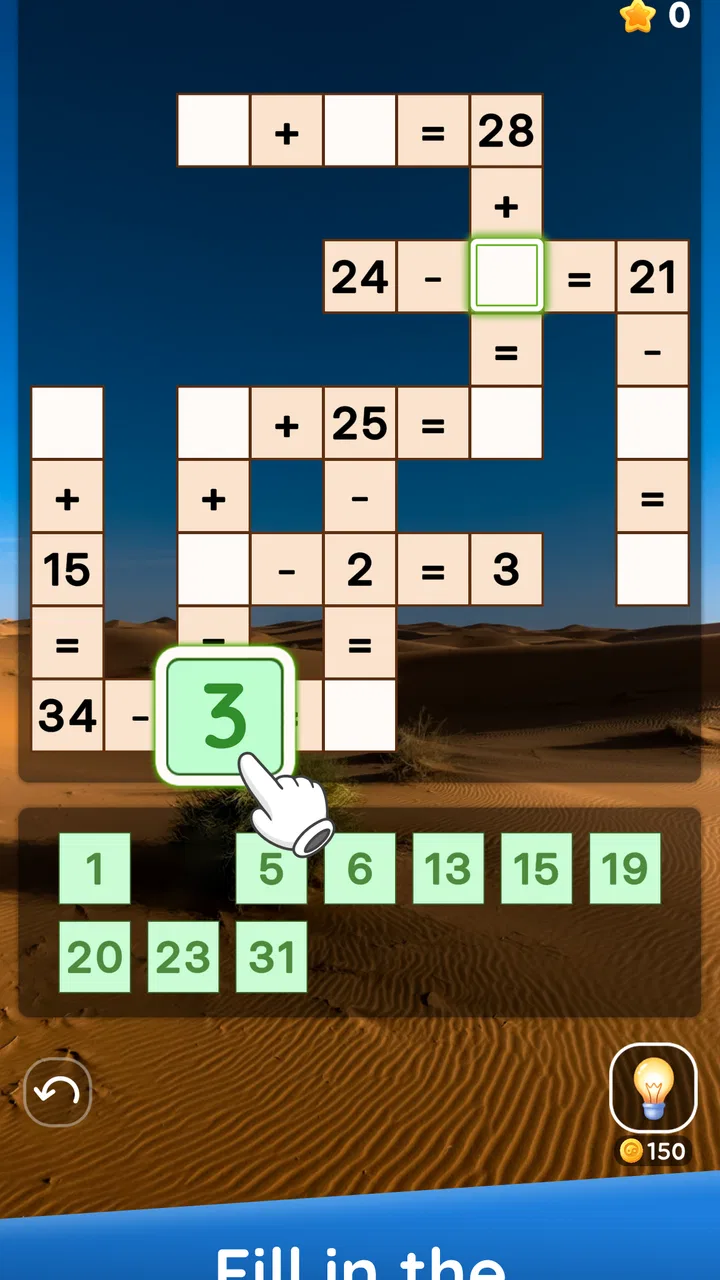
I approached Zen Math Crossword expecting a small arithmetic diversion, but it works better when treated as a calm, focused board game rather than a conventional math lesson. The idea is simple: you solve crossword-style number puzzles by working through arithmetic clues, filling the board one answer at a time. That familiar layout makes the game feel less intimidating than a worksheet, while the numbers keep each move mentally active.
It is a free board game from Spill Games, suitable for Everyone and available for devices running Android 8.0 or later. The game reached the store on April 30, 2025, and the current version is 1.38. Its average rating is 4.9 from around 6.6K ratings, with 100K+ installs, so it has already attracted a meaningful group of players without feeling like an overloaded mainstream game.
What to expect when you begin
The first thing to understand is that this is not a fast arcade game. There are no reflexes to master and no complicated character or world to learn. The board is the challenge. Each completed entry gives you information that helps with the crossing entries, so progress comes from combining arithmetic with the structure of the puzzle.
You May Also Like

 Blood Strike: 2.5 Anniversary
Blood Strike’s Loadouts Turn Every Drop Into a Tactical Gamble
A close look at Blood Strike’s custom loadouts: how fast access to signature weapons reshapes its battle royale rhythm, rewards preparation, and narrows the gap between fights.

 Pandora - Music & Podcasts
Pandora’s Music Is Easy to Start, but Harder to Recover
Pandora’s strength is its low-effort path from a seed to a station. Its weak spot is how much confidence it asks you to place in connection, setup, and quiet recovery.

 8 Ball Pool
 Is Built on Rivalries, Rematches, and Routine
A close look at the rivalries, rematches, shared routines, and unanswered safety questions that turn a quick pool match into a persistent mobile community.

 Samsung Music
’s Quiet Strength Is Playing What You Already Own
Its reach comes less from spectacle than from dependable access to a personal library. That simplicity is both the app’s strongest retention engine and its ceiling.

 AccuWeather: Weather Radar
AccuWeather Review: A Quick, Clear Forecast for Everyday Decisions
For everyday plans, the best forecast is the one you can understand quickly. AccuWeather makes rain timing, radar, and local conditions easy to act on, with a few trade-offs.

 Hill Climb Racing
Why Hill Climb Racing Still Turns Crashes Into One More Run
A tiny car, a bumpy hill and one more upgrade: Hill Climb Racing keeps resurfacing because its simple chaos makes every near-miss feel personal.
More From Our News Desk
View All News


That combination is the main appeal. If I get stuck on one clue, I can often move to another part of the board, solve an easier equation, and use the resulting number as a guide. This makes the experience feel more like untangling a problem than repeatedly guessing answers. It also gives the game a useful rhythm for short sessions: solve, check the crossings, reconsider, and continue.
The “zen” part of the name is important to the overall impression. I would not describe the game as completely effortless, because some puzzles demand concentration, but it has a quieter mood than many mobile games. It suits a coffee break, a few minutes before bed, or a moment when I want to stay mentally engaged without opening a competitive multiplayer game.
Players looking for a deep traditional crossword should adjust their expectations. The focus here is arithmetic, not vocabulary, clues, themes, or wordplay. Likewise, anyone wanting a full mathematics course may find the experience too light. Its strength is the middle ground: it turns basic calculations into a repeatable puzzle habit.
The game is free to start, with in-app purchases ranging from $1.99 to $99.99 per item. That makes it easy to try without paying first, but I would still recommend checking the purchase flow carefully before handing the game to a child. The Everyone rating describes the intended age suitability, while the optional spending is a separate practical consideration for families.
Installing it without overthinking the choice
For a first-time player, the requirements are reassuringly modest. If the device runs Android 8.0 or newer, the operating-system requirement is covered. I would install it when I have a few uninterrupted minutes rather than opening it during a rushed task, because the first useful impression comes from actually completing a small section of the board.
There is no reason to approach the game as if I need prior crossword experience. The board format may look unfamiliar at first, but the important skill is not knowing crossword conventions. It is recognizing the arithmetic operation, calculating carefully, and noticing how the answer fits with the crossing spaces.
My advice is to begin with a relaxed mindset. Trying to solve every visible clue immediately can make the board seem harder than it is. Instead, I look for the most approachable equation, solve that one, and use the new number to narrow down nearby possibilities. This is the first useful habit to develop, and it works better than staring at the most difficult clue until frustration builds.
The first meaningful success
The first satisfying moment is not necessarily finishing an entire puzzle. It is completing one entry and then using it to unlock another. That small chain shows how the board is meant to be read. A correct answer is valuable twice: it solves its own clue and provides a fixed point for the surrounding crossings.
When I play, I try to separate calculation from placement. First I work out the arithmetic mentally or on paper if needed. Then I check whether the answer fits the available spaces and the crossing numbers. This two-step approach reduces careless mistakes, especially when several answers look plausible. It also helps distinguish a calculation error from a placement misunderstanding.
A practical routine for beginners is to scan for short or familiar calculations, enter the answers that feel certain, and then revisit the clues that intersect them. If a later crossing does not fit, I do not immediately assume the whole board is wrong. I recheck the operation, the order of the numbers, and whether I copied the answer into the right position.
The best early strategy is to build certainty from the easiest crossings, not to force the hardest clue first. That sounds obvious, but it changes the game from a guessing exercise into a process of deduction. It is also one of the reasons the format can suit casual players who do not usually choose math games.
For children, this can become a gentle way to practice arithmetic without presenting itself as a formal lesson. For adults, it works as a low-pressure mental warm-up. I would not use it as the only tool for improving mathematics, but it can make repeated calculation feel more approachable and less repetitive than drilling isolated sums.
Where beginners may feel confused
The main source of confusion is likely to be the relationship between the arithmetic clue and the crossword layout. A player may calculate a correct answer and still wonder why it does not fit. In that situation, I would inspect the number of spaces and the crossing entries before recalculating. The board is not simply asking, “What is the answer?” It is also asking, “Where does that answer belong?”
Another common mistake is treating every clue as equally urgent. They are not. Some entries are useful because they cross several others, while a clue at the edge may provide less immediate information. When I have a choice, I prefer the answer that connects with more of the unfinished board. That creates more opportunities to confirm whether my calculations are correct.
It is also easy to rush familiar operations. Arithmetic that feels simple can still produce an incorrect entry when I am moving quickly, and one wrong number can make several nearby clues appear impossible. Slowing down for a quick mental check is usually faster than trying to repair a whole section later.
If a puzzle begins to feel stuck, I take a short break instead of repeatedly entering guesses. Returning with a fresh look often makes a known clue easier to see. This is where the calm design works in the game’s favor: there is more value in patient checking than in frantic tapping.
Players who expect a large collection of dramatic game mechanics may also wonder whether the experience is too restrained. That is a fair concern. The appeal depends on enjoying the puzzle itself. If I want elaborate progression, action, social competition, or a story campaign, this is probably not the right board game for me. Its reward comes from solving the grid, not from surrounding spectacle.
How it fits into an everyday routine
I can imagine using it during a short morning break. Rather than scrolling through several unrelated posts, I might open a puzzle, solve a few entries, and stop after reaching a natural point. The session gives my attention one clear target without requiring the commitment of a long game.
It can also work as a shared activity between an adult and a child. One person can read the arithmetic clue while the other checks the crossings, turning the board into a conversation about how an answer was reached. The game’s Everyone rating supports that broad audience, although I would keep the optional purchase aspect in mind when a younger player uses the device independently.
For adults who are rebuilding confidence with basic arithmetic, the crossword structure offers a useful psychological advantage. A mistake is part of a larger puzzle rather than a marked exercise on a page. The crossings provide hints, so the player is not relying only on memory or speed. That makes it more forgiving than a bare calculation app, even though accuracy still matters.
On the other hand, students who need targeted practice with one specific topic may be better served by an educational app designed around that topic. Zen Math Crossword is more flexible and recreational. It encourages repeated thinking, but it does not replace a structured curriculum, worked explanations, or teacher feedback.
Small techniques that make the board easier
My first non-obvious tip is to prioritize answers that cross several unfinished entries. A correct number in a central position can reveal multiple letters or values around it, depending on how the board is arranged. This is usually more efficient than solving clues in visual order from top to bottom.
My second tip is to keep a mental distinction between “certain,” “probable,” and “unresolved” answers. I treat a result as certain only when both the arithmetic and the crossings agree. A probable answer may be mathematically correct but still need confirmation from the board. This prevents one early assumption from controlling the rest of the puzzle.
My third tip is to use the game as a concentration timer rather than chasing a long session. I choose a small target, such as completing a connected cluster, and stop when I reach it. That keeps the experience relaxing and makes it easier to return later without feeling that I abandoned an unfinished obligation.
A fourth useful habit is to recalculate from the original clue whenever something looks inconsistent. It is tempting to infer that a neighboring answer must be wrong, but the error may be a transposed digit or a rushed operation in the entry I thought was secure. Going back to the clue is more reliable than adjusting answers by intuition.
What changes as you become comfortable
Once the basic process feels natural, the game becomes less about individual sums and more about managing information. I start choosing clues based on how much of the board they can clarify. A simple calculation with several crossings may be more valuable than a harder calculation isolated at the edge.
This also creates a useful trade-off between speed and confidence. Moving quickly can feel satisfying, but a single careless answer may create extra work. Playing more deliberately usually produces a smoother session, especially when the board contains several similar-looking operations. I prefer accuracy first, then speed as a side effect of familiarity.
The game’s high average rating and growing install count suggest that this straightforward approach is connecting with players, but popularity does not remove the personal question of fit. I would recommend it to someone who likes number puzzles, wants a quiet mobile activity, or enjoys crossword layouts but does not necessarily want word clues. I would be less likely to recommend it to someone who needs advanced mathematics, competitive pressure, or a highly varied visual game.
The developer, Spill Games, has positioned the title in the board-game space rather than presenting it as a formal study tool. That distinction matters. I judge it by whether the puzzle loop is pleasant and clear, not by whether it teaches every mathematical concept in depth. On that basis, the focused design is an advantage for casual play, though it may feel narrow after long sessions for players who need constant novelty.
When another option may suit you better
A traditional crossword is a better choice if I want language, clues with multiple meanings, cultural references, and a larger vocabulary challenge. A standard calculator or arithmetic trainer is better if my goal is speed, repetition, or practice with a precisely chosen operation. A competitive board game is better if I want opponents, rankings, or social interaction.
Zen Math Crossword sits between these alternatives. It borrows the crossing logic of a crossword, but replaces word recall with arithmetic. Compared with a plain math drill, it gives each answer a place in a larger structure. Compared with a traditional crossword, it reduces the need for language knowledge and makes the challenge more concrete.
That middle position is exactly why I think the game can appeal to families and casual players. It does not demand specialist knowledge, but it still asks for more thought than tapping through a passive distraction. The limitation is that players who dislike numbers will not be rescued by the crossword format; arithmetic remains the center of every meaningful move.
My recommendation after settling into the puzzle loop
After using the game with a beginner’s approach, I see it as a focused, approachable choice for short sessions. The path from installation to success is clear: open a board, find a calculation you trust, place the answer carefully, and use the crossings to guide the next move. That first chain of correct entries is enough to show whether the format suits you.
I appreciate that the game can be relaxing without becoming completely passive. It gives me a reason to slow down, check my thinking, and notice how one answer affects the rest of the board. The free entry point makes trying it straightforward, while the optional purchases mean I would review the spending controls before letting a child play unsupervised.
My honest reservation is variety of purpose rather than a specific flaw: this is a specialized puzzle game. It will not replace a math-learning platform, a word crossword, or a competitive board game. But if you want arithmetic wrapped in a calm crossword structure, it is a convincing fit. I would recommend Zen Math Crossword to first-time puzzle players who want an encouraging start, adults looking for a quiet mental break, and families seeking a simple number activity that can be discussed together.
For me, the strongest reason to keep it installed is the way it turns a small amount of arithmetic into a connected problem. I can play for a short while, finish a meaningful section, and leave with the satisfying feeling that I solved something rather than merely passed time. That is a modest goal, but this game understands it well.
FAQs for Zen Math Crossword
01What is Zen Math Crossword and how does it work?
Zen Math Crossword is an engaging puzzle game that combines crossword-style grids with mathematical challenges. Players solve math equations to fill in the grids, providing an entertaining way to enhance problem-solving skills. The app offers various difficulty levels, making it suitable for both beginners and math enthusiasts.
02Is Zen Math Crossword suitable for all age groups?
Yes, Zen Math Crossword is designed for all age groups. The game features adjustable difficulty levels, allowing players of any age to enjoy and benefit from it. Younger players can start with simpler puzzles, while more experienced users can challenge themselves with complex grids.
03Does Zen Math Crossword require an internet connection?
No, Zen Math Crossword can be played offline. This makes it perfect for travel or situations where internet access is limited. However, to access updates and new puzzle packs, an internet connection will be needed occasionally.
04Are there in-app purchases in Zen Math Crossword?
Yes, Zen Math Crossword offers in-app purchases. While the basic version of the game is free, players can purchase additional puzzle packs or unlock ad-free gameplay to enhance their experience. These purchases are optional and not necessary to enjoy the standard gameplay.
05How does Zen Math Crossword help improve math skills?
Zen Math Crossword helps improve math skills by providing a fun, interactive way to practice arithmetic and logical thinking. Players are required to solve equations and think strategically to complete the grids, which strengthens their mathematical reasoning and problem-solving abilities over time.
Pros
- Engages users with challenging puzzles.
- Enhances logical thinking and math skills.
- Offers daily puzzles for consistent engagement.
- User-friendly interface with intuitive controls.
- Minimal ads
- ensuring uninterrupted gameplay.
Cons
- Limited hints can frustrate beginners.
- No multiplayer mode for collaborative play.
- Occasional bugs in older devices.
- Puzzles can become repetitive over time.
- Requires internet for accessing new puzzles.

Zen Math Crossword
Gallery